04 December 2025
Tampelas Project Received ISOCARP Grand Award 2025
Tampelas captures a truth many remote communities across Indonesia are now confronting: that an extractive economy may offer survival, but it cannot offer a future.
Tampelas Project brings multi-stakeholder partners together to address activities such as illegal mining and unsustainable plantation expansion that accelerate deforestation and heighten fire risks.
Tampelas project taken on August 2024.
Located within a productive forest, Tampelas’ peatlands require urgent protection; a locally rooted snakehead fish cultivation model helps rewet the peat, enhance carbon storage, and produce high-value products such as albumin to strengthen community income. This demonstrates how sustainable land-use practices can support both livelihoods and environmental stability.
Through community-based programs, biodiversity preservation, climate-sensitive design, local materiality, and renewable energy provision, Tampelas is shifting from depletion toward a restorative economy and healthier ecosystems. It is a grounded transition shaped by local knowledge and built around shifting intent to action through design-led interventions.
Recognized by Global Planning Communities
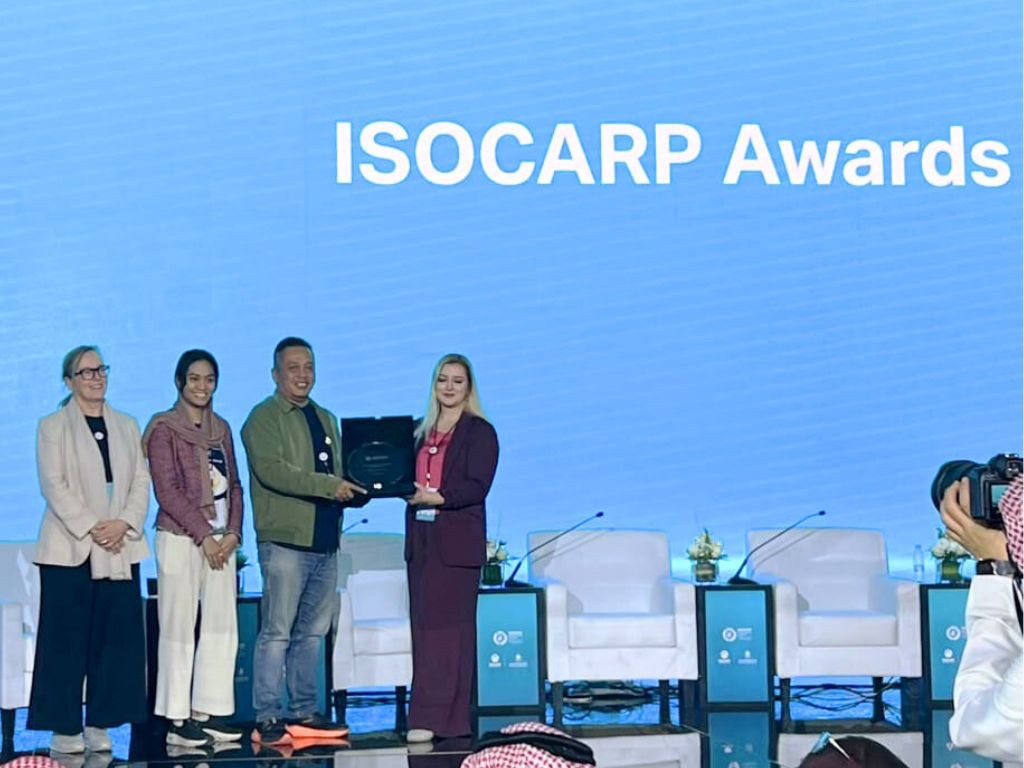
In recognition of its transformative approach in implementation, the project later received ISOCARP Awards for Excellence 2025 – Grand Award (Realized Project) from the International Society of City and Regional Planners, a body representing diverse planning professionals from around the world. This award was presented on December 2nd, 2025, in Riyadh, Kingdom of Saudi Arabia.
Earlier, its planning foundation had earlier been acknowledged in the region through a Gold award from the Singapore Institute of Planners in 2023 for Excellence in Planning for Community Engagement and Social Inclusiveness.
Tampelas stands as a quiet but powerful example of how a restorative economic model can take root in Indonesia’s forest communities.
[PDW/PSY]