25 May 2026
PDW Newsletter04 Connecting Places, Connecting Opportunities
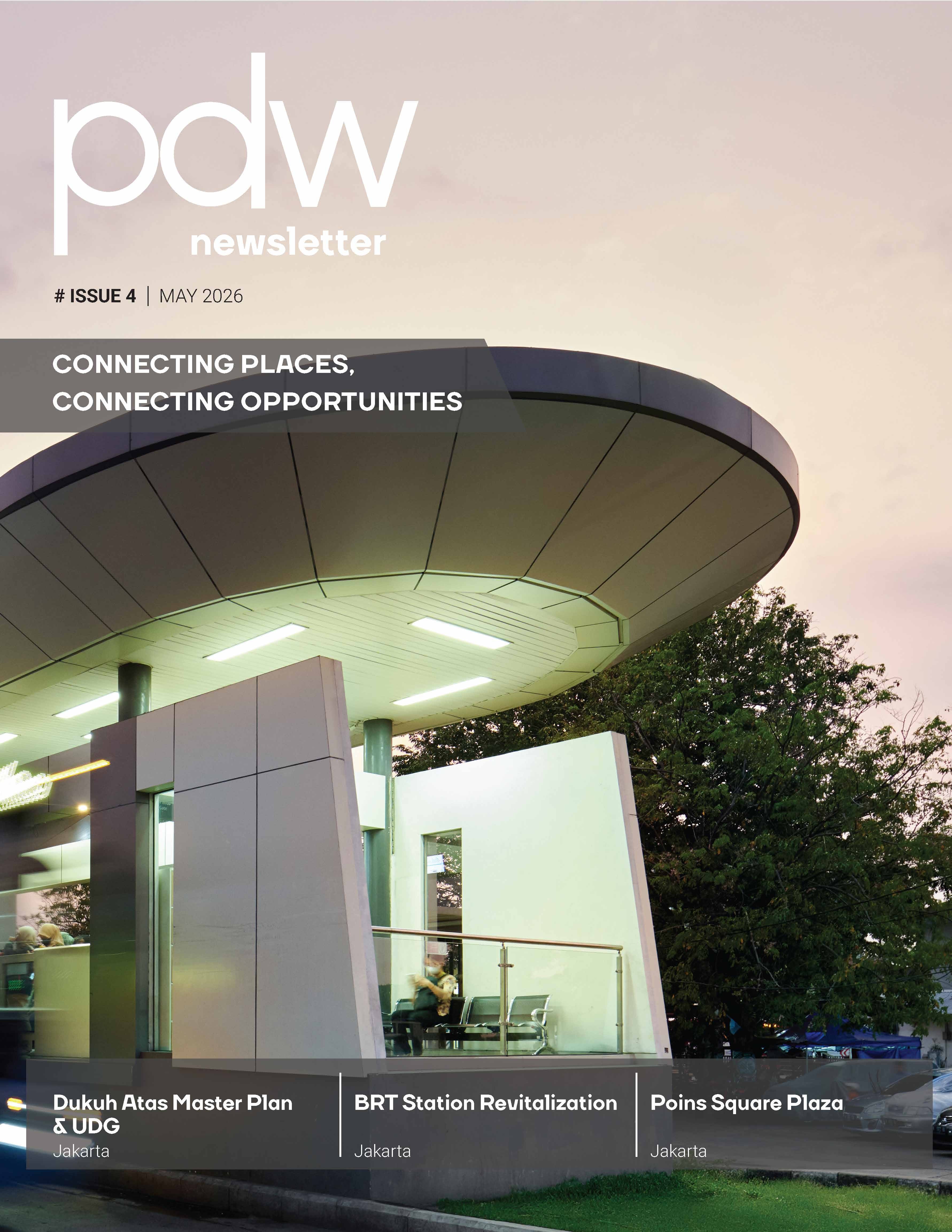
At its core, our practice at Pandega Desain Weharima (PDW) has always been concerned with connection—not only as infrastructure, but as a spatial experience that shapes everyday life within Jakarta's transit network. From transit nodes to pedestrian networks and building entrances, each project contributes to a larger urban system that extends beyond individual sites. In this fourth edition, we bring together a series of works that reflect this approach: rethinking transit stops as everyday interfaces, extending access through pedestrian connections, and reconsidering entrances as critical thresholds between buildings and the city.
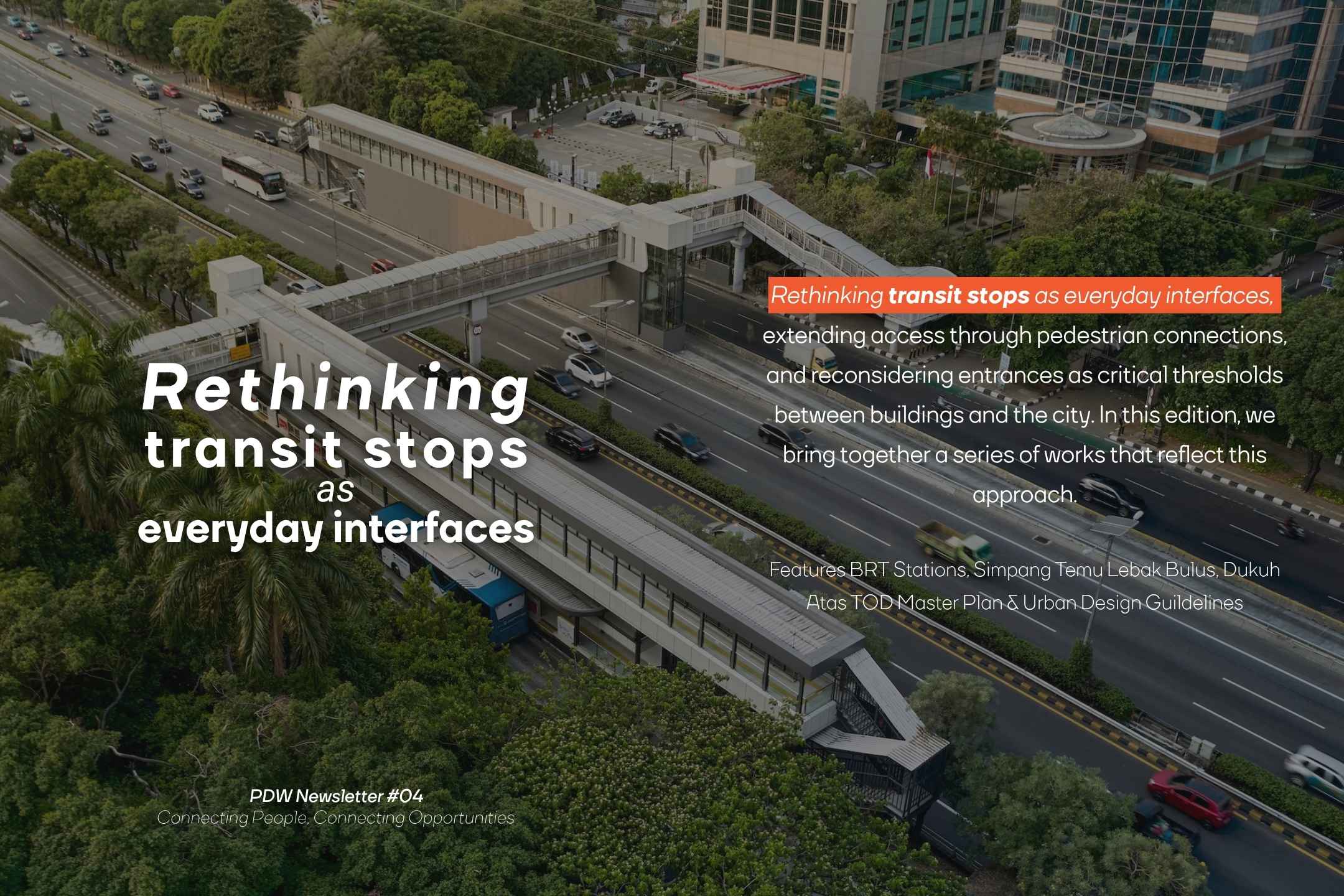
Transit architecture that carries thousands of people a day asks different questions.
Not how long people stay, but how clearly they move, how comfortably they wait, and whether the space holds them with some dignity in between. For Jakarta's commuters, many of whom spend upward of an hour each way navigating the city, a BRT station or a pedestrian skywalk is both a gateway into the network and, briefly, a pause from the demands of getting somewhere. That dual role shapes every design decision: how air moves through the space, where a column sits, how a prayer room is positioned so it serves without disrupting the flow.
These are architectural decisions. Specific, and consequential in ways that only become visible when they go wrong.
In the fourth edition of the PDW newsletter, Connecting Places, Connecting Opportunities, we bring together three projects that worked through this, at different scales, but with the same question running through each.
Transjakarta BRT Station Revitalization. Senen Sentral, Pulogadung, Kebayoran, and two others across the city. Each shelter is part of a larger transit network, which means each one carries a responsibility beyond its own footprint. The design had to accommodate high-volume movement while remaining legible, comfortable, and dignified for the commuter who passes through it twice a day, every day. As a tropical building, thermal performance and natural ventilation were not secondary concerns, they were structural to whether the space could actually be used.
Poins Square Plaza. A pedestrian skywalk connecting Lebak Bulus MRT Station to Poins Square. At this scale, the architectural challenge shifts from shelter to continuity: how do you extend the logic of a transit station into a covered pedestrian connection without it feeling like a corridor? The plaza (Simpang Temu Lebak Bulus) and skywalk are the interfaces, between two buildings, two programs, two different kinds of movement, and that interface needed to be resolved spatially, not just functionally.
Dukuh Atas TOD Master Plan and Urban Design Guidelines. At the urban design scale, the question becomes systemic: how do individual buildings, ground-floor activations, and pedestrian networks cohere into a transit-oriented district that actually functions as one? The master plan and guidelines work at the level of rules and frameworks, defining what each piece of the district owes the whole.
Three projects. Three scales. What connects them is not a single formal language but a consistent design position: that spaces designed for movement still owe their users something beyond efficiency. Shade. Orientation. A place to stop, briefly, without feeling like an obstruction.
That position is what this edition of the newsletter documents.
Three projects. Three scales. What connects them is not a single formal language but a consistent design position: that spaces designed for movement still owe their users something beyond efficiency. Shade. Orientation. A place to stop, briefly, without feeling like an obstruction.
Explore the full PDW Newsletter archive.
[PDW/FTM, PSY]